
B is for Bias: What Every Business Owner Needs to Know About AI Bias
AI bias is silently affecting small businesses through chatbots and CRMs. Learn what it is, where it comes from, and how to protect your business.

// WATCH THE EPISODE
AI in Business on YouTube
Prefer video? Watch this week's full breakdown on the AI in Business YouTube channel.
Introduction
Imagine using a hiring tool that systematically excluded every candidate over 45. Or a lead scoring system that quietly deprioritised prospects with non-English names. That is not science fiction. That is happening right now, and it is called AI bias.
Welcome back to the AI in Business Academy. In the last lesson, we covered the foundations. We talked about what an algorithm is, how it works, and where algorithms already sit inside your business. If you have not read that article yet, go and check it out. In today’s lesson, we are building exactly on those core concepts. Today, we are talking about something that does not get nearly enough attention in the AI conversation, especially among business owners. We are talking about bias.
By the end of this lesson, you will understand what AI bias is, where it comes from, why it is a genuine business risk, and what you can do about it, even if you are running a small business with a handful of staff. Let us get into it.
What is AI Bias?
Let me start with a simple definition. AI bias is when an AI system produces results that are systematically unfair or inaccurate for certain groups of people.
Now, every AI system will get things wrong sometimes. It is not a magic wand. That is not bias though. Bias is when the system is consistently wrong in ways that disadvantage specific people. It is not a random error. It is a pattern.
And here is where it connects back to what we covered in the last lesson. Remember, an algorithm follows a three-part structure: input, process, output. Bias can creep in at every single stage.
The input is the data the system learns from. If that data reflects historical human prejudices, an algorithm learns those prejudices. The process is how the algorithm weighs different factors. If the designers made choices that inadvertently favoured one group over another, that gets baked into the logic. And the output is the decision the system makes. If nobody is checking those decisions for fairness, bias goes undetected.
The important thing to understand is that AI bias is almost never intentional. Nobody sits down and programs a system to discriminate. It happens because the data the system learned from was already biased, and the algorithm faithfully reproduced those patterns at scale, faster and more efficiently than a human could.

Where Does Bias Come From?
There are three main sources of bias, and all of them are more common than you might think.
The first and biggest source is the training data. AI systems learn from historical data, and historical data is full of human decisions. If those decisions were biased, the AI learns that bias as if it were a rule.
The Amazon hiring example is the clearest case of this. Amazon trained a recruitment algorithm on ten years of hiring data. Most of those hires had been men. So the algorithm learned that male candidates were preferable and started penalising CVs that included the word “woman.” The algorithm was not sexist. It was doing exactly what it was trained to do. The problem was the data.
But it is not just hiring. In healthcare, skin cancer detection tools trained mostly on light skin patients have been shown to miss or misdiagnose conditions in patients with darker skin tones. Over 80% of the training data in some of these systems came from Caucasian patients. The AI literally did not learn what certain conditions look like on darker skin because it was never shown enough examples.
And in the US criminal justice system, an algorithm called COMPAS was used to predict whether defendants would re-offend. A major investigation found that Black defendants were nearly twice as likely to be wrongly flagged as high risk compared to white defendants. The algorithm does not use race as an input, but it used data points like prior arrests, which were themselves shaped by decades of disproportionate policing. The bias was baked into the system long before the algorithm was built.
The second source is data selection. This is about who gets included in the data and who gets left out. If your training data under-represents certain groups, the AI will perform worse for those groups. The skin cancer example shows this clearly. It is not that anyone chose to exclude darker-skinned patients. They were just underrepresented in the data sets, and nobody checked.
The third source is design choices. Every AI system has to decide what to measure and what to prioritise. Those choices have consequences. A study on healthcare cost prediction at UC Berkeley found that an algorithm used healthcare spending as a proxy for healthcare need. But Black patients historically spent less on healthcare, not because they were healthier, but because of systemic barriers to access. So the algorithm rated healthier white patients as higher priority than sicker Black patients. The metric it was optimising for was the wrong one.

Why Should Small Businesses Care?
You might be thinking these are all big corporate examples. Amazon, healthcare systems, criminal justice. What does this have to do with my business, James? More than you think.
Let me start with the legal risk. Discrimination claims related to AI are rising. In the US, the Equal Employment Opportunity Commission received over 88,000 workplace discrimination charges in 2024, more than 9% up from the year before. Courts are now holding both AI vendors and the businesses that use their tools liable for biased outcomes.
A landmark case against Workday, the HR software company, is proceeding on the basis that their AI hiring tools caused disparate impact discrimination. The key legal precedent is this: using a vendor’s tool is not a defence. If the tool discriminates, you are responsible. And for those of us in the UK, the Equality Act covers both direct and indirect discrimination, and the same principle applies.
But here is the thing. The legal risk is actually the smaller problem for small businesses. The bigger risk is reputational damage. Research shows that 36% of companies surveyed had suffered losses due to AI bias. Of those, 62% lost revenue, 61% lost customers, and 43% lost employees. And only 35% actually faced legal action.
That means the majority of businesses damaged by bias never went to court. They just lost trust. And trust is harder to rebuild than a legal settlement. When biases are discovered, customers do not just feel treated unfairly. They question whether the business is competent, and that is a different kind of damage to a one-off mistake. And as you know, reputation means everything in our small businesses.
For a small business without a big PR team or a crisis communications budget, a viral complaint about biased AI can do serious harm. And it does not need to be a lawsuit. It just needs to become known.
Bias in the Tools Small Businesses Use Every Day
Let me bring this closer to home because bias is not just a problem in headline-grabbing AI systems. It is sitting quietly inside the tools small businesses use every day.
Customer service chatbots. If you are using an off-the-shelf chatbot, it was trained on somebody else’s data. That data may not represent your customer base. A chatbot that struggles with certain accents, communication styles, or non-English names is not giving all your customers the same experience. And the tricky part is that it will work well enough for most people. You will not notice the problem unless you actually test for it.
So I will give you a personal example. My business operates across the UK, Saudi Arabia, and the UAE. When we set up AI tools that interact with our customer base, the first thing I do is test them with Arabic names and communication patterns. Because if half of your client base is in the Gulf and your AI tools are trained on data from Birmingham and Boston, you have a problem that nobody else is going to flag for you. You have to check it yourself.
Lead scoring. Your CRM’s lead scoring algorithm might be assigning lower scores to prospects from certain postcodes, with non-English business names, or from demographics that were unrepresented in the training data. One study found that non-English names received 40% fewer automated marketing opportunities. That is not just unfair. That is missed revenue.
There are real examples of this in the wild. A Manchester boutique was misclassified by an AI system as miscellaneous retail instead of a fashion retailer, which reduced its visibility in ad platforms. A halal butcher shop with 15 years of strong reviews was excluded from local food retailer campaigns because the AI’s definition of food retail was too narrow.
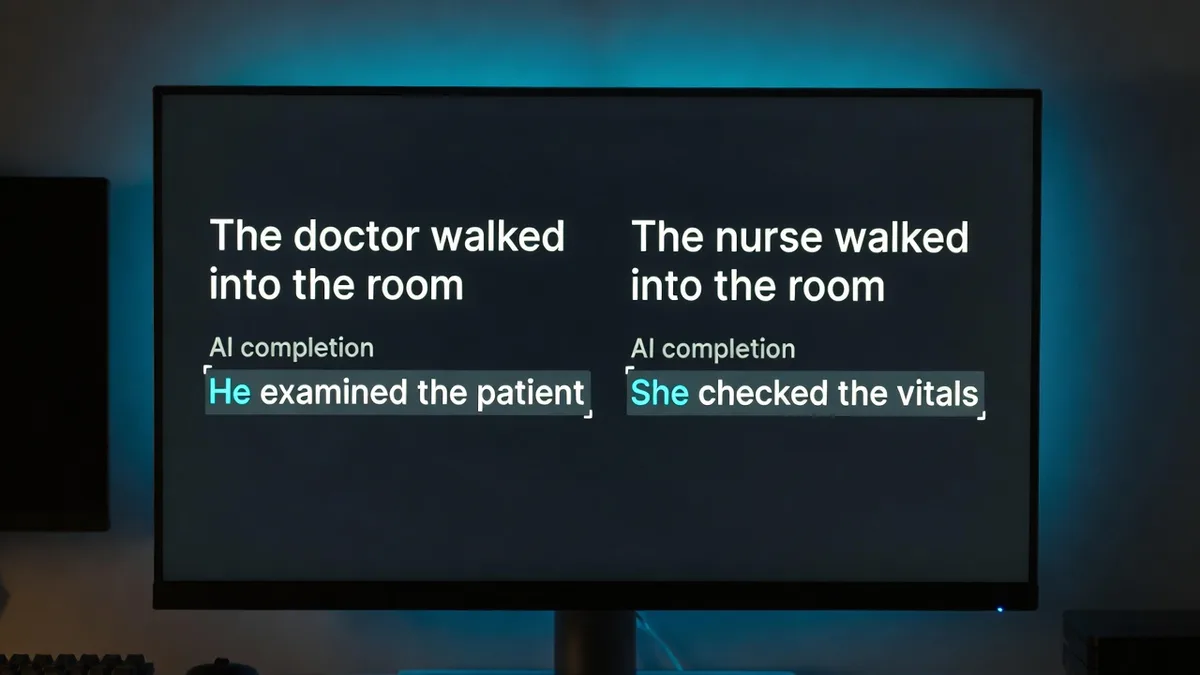
And the AI tools that many businesses now use for content and customer communication, tools like ChatGPT and Claude, can also exhibit bias. Tests have shown these models reinforce gender stereotypes, assigning “heater” doctors and “sheater” nurses in neutral prompts. If you are using these tools to draft customer-facing content without reviewing the output, one, you are mental, and two, you could be publishing biased material without realising it. So always check anything that comes out of an LLM.
None of these examples involve malicious intent. They are all results of systems learning from incomplete or skewed data, and that is exactly what makes bias so dangerous for small businesses. It is invisible until someone notices a pattern.
How to Spot and Address Bias
So how can you spot and address bias? What can you actually do about it? You do not need a data science team, but you do need to start paying attention.
The first thing is to ask the right questions. Before you adopt any AI tool that makes decisions affecting people, whether it is customers, staff, or suppliers, ask: what data was this trained on? Who is represented in that data, and who might be missing? If the vendor cannot answer those questions clearly, you should give it a pause.
The second thing is to test it yourself. This is simpler than most people think. Take your AI hiring tool and run 20 identical CVs through it. Change only the name. Use names that suggest different genders, ethnicities, and ages, and see if the scores differ. Do the same with your chatbot. Ask the same question but swap the customer name between Sarah and Mohammed, for example, and check whether the tone, speed, or resolution offered changes.
And these are not complex technical audits. You can nominate one of your team or do it yourself. It is basically a sense check that takes an hour or two, and it will tell you more about your AI tools than any vendor’s marketing material.
The third thing is to keep humans in the loop for any high-stakes decisions. If an AI system is making decisions that directly affect someone’s livelihood, their access to service, or their money, a human should be reviewing those decisions without fail. Not rubber-stamping them. Actually reviewing them.
The best implementations of AI in business keep humans overseeing the outputs, especially for edge cases and anything that feels off. Whenever we work with businesses, what we generally do when we identify a process that we want to incorporate automation into or incorporate an AI tool is we will start off with what we call a “humans in the loop” process. So you might have one process, and it will have five or six interjections of humans actually testing the process. The more and more we run it and the more and more we improve the process, then you start removing these checks until ultimately you have got one or two, which is maybe just a steer and a final check.
The fourth thing is to monitor over time. Checking for bias once is not enough. AI systems can drift. The data changes, the patterns shift, and biases can emerge that were not there at launch. A bank’s fraud detection AI was found to have developed bias against older customers over several months of undetected drift. Nobody noticed until customers started complaining. Simple monitoring like reviewing the outcome by customer segment on a regular basis catches these problems early.
The Opportunity in Getting This Right
Now I do not want to leave you thinking this is all doom and regulation. There is a genuine business opportunity here for companies that get ahead of this.
Most of your competitors are not thinking about AI bias at all. They are buying tools, plugging them in, and hoping for the best. If you are the business that tests tools for fairness, that can explain to customers how your AI makes decisions, and that catches problems before they become complaints, you have a competitive advantage. Customers increasingly care about how businesses use technology. Being transparent about your AI practice builds trust, and trust, especially for small businesses, is everything.
The business that takes bias seriously now will also be prepared for the regulation. We are super early on the AI curve, and regulation is on the horizon. The EU AI Act is coming, and the UK is moving in the same direction. Just making sure your house is in order before the regulation arrives is far cheaper and less disruptive than scrambling to comply after the fact.
Key Takeaways
-
The definition. AI bias is when a system produces results that are systematically unfair to certain groups. It is almost never intentional. It comes from the data the system learned from, who was included, who was left out, and what the system was told to optimise for.
-
The business risk. Bias is not just an ethical issue. It is a legal risk, a reputational risk, and a revenue risk. Most businesses damaged by AI bias never go to court. They lose customers, they lose trust, and they lose money. And for small businesses, that damage is much harder to absorb.
-
The action. You do not need to be a technical expert to address bias. Ask what data the tool was trained on, test it with diverse scenarios, keep humans in the loop for decisions that matter, and monitor over time. Those four steps put you ahead of the vast majority of businesses using AI tools today.
So to distill this lesson down to one line: AI bias is a pattern, not a glitch, and it is your responsibility to check for it, even if you did not build the tool.
Over to You
Have you ever spotted bias in an AI tool you use? What happened and how did you handle it? Drop a comment below.
Enjoyed this? Get The Boardroom AI Brief.
Every Tuesday, the 10 AI developments that actually matter for SMEs. One short email. Free.
Free · no spam · unsubscribe any time

// WRITTEN BY
James Anderson
AI and full-stack engineer helping SME owners understand and implement AI. Founder of AI in Business and host of the AI in Business channel on YouTube.
Learn more about James →[ MORE ] RELATED READING
You might also like.
// NEXT MOVE
Get the AI news that matters, every week.
Join The Boardroom AI Brief. One free email every Tuesday: the AI developments that matter for your business, rated for relevance and explained in plain English.