E is for Embeddings
Embeddings are a way of converting words and concepts into numbers that capture meaning, enabling AI to understand what you mean rather than just what you type.

// WATCH THE EPISODE
AI in Business on YouTube
Prefer video? Watch this week's full breakdown on the AI in Business YouTube channel.
TL;DR
Embeddings are a way of converting words and concepts into numbers that capture meaning, enabling AI to understand what you mean rather than just what you type. This technology powers semantic search, allowing queries like “HR policy” to return “hiring guidelines” and “staff handbooks” even without exact keyword matches—a fundamental shift from keyword matching that is transforming how businesses search documents, detect customer intent, and power recommendations.
Table of Contents
- What Are Embeddings and Why Do They Matter for Your Business?
- How Semantic Search Works Using Embeddings
- Four Real Business Use Cases for Embeddings
- Keyword vs Semantic Search: When to Use Each
- The Limitations of Embeddings
Introduction
You ever search your documents for “HR policy” and somehow it finds “hiring guidelines” and “staff handbooks” too? That is not magic. That is embeddings.
Now, this is one of those concepts that sits at the heart of modern AI. Without embeddings, none of the tools you have probably been hearing about would work the way they do. Today I am going to break down exactly what embeddings are, why they matter for your business, and when it is worth investing in versus when keyword search will do just fine.
In this guide, you will learn how embeddings transform raw text into numerical representations that capture meaning, explore real-world business applications, and discover a simple framework for deciding whether your business needs semantic search or traditional keyword matching.
What Are Embeddings and Why Do They Matter for Your Business?
At their core, embeddings are a way of turning words and concepts into numbers. But not just any numbers—these numbers capture meaning. Let me explain what I mean by that.
Imagine you have a librarian who organises books not by title and not by author, but by what they are about. This librarian puts all the books about love stories in one section, all the books about detective mysteries in another, and all the books about cooking in a third. Books that share similar themes sit close together on the shelves. A romance novel sits next to another romance novel, not next to a cookbook, because even though they might share some words, they are about completely different things.
That is essentially what embeddings do. They take words, phrases, documents, or even images, and convert them into a list of numbers that represent what they mean. And here is the clever part: if two things have similar meanings, their numbers end up close together. If they are about different things, their numbers are far apart.
Embeddings are the foundation that makes semantic search possible, and that is why they matter for your business.
So why does this matter for your business? Well, this is the technology that lets modern AI understand what you mean, not just what you type. It is the reason a search for “HR policy” will find your hiring guidelines, your staff handbook, and your leave policy, even though none of those documents contain the exact words “HR policy.”
This shift from matching exact words to understanding underlying meaning is what separates traditional search from semantic search—and it is fundamentally changing how businesses access their own information.

How Semantic Search Works Using Embeddings
Now let me explain how semantic search actually works, because this is where embeddings show their real power.
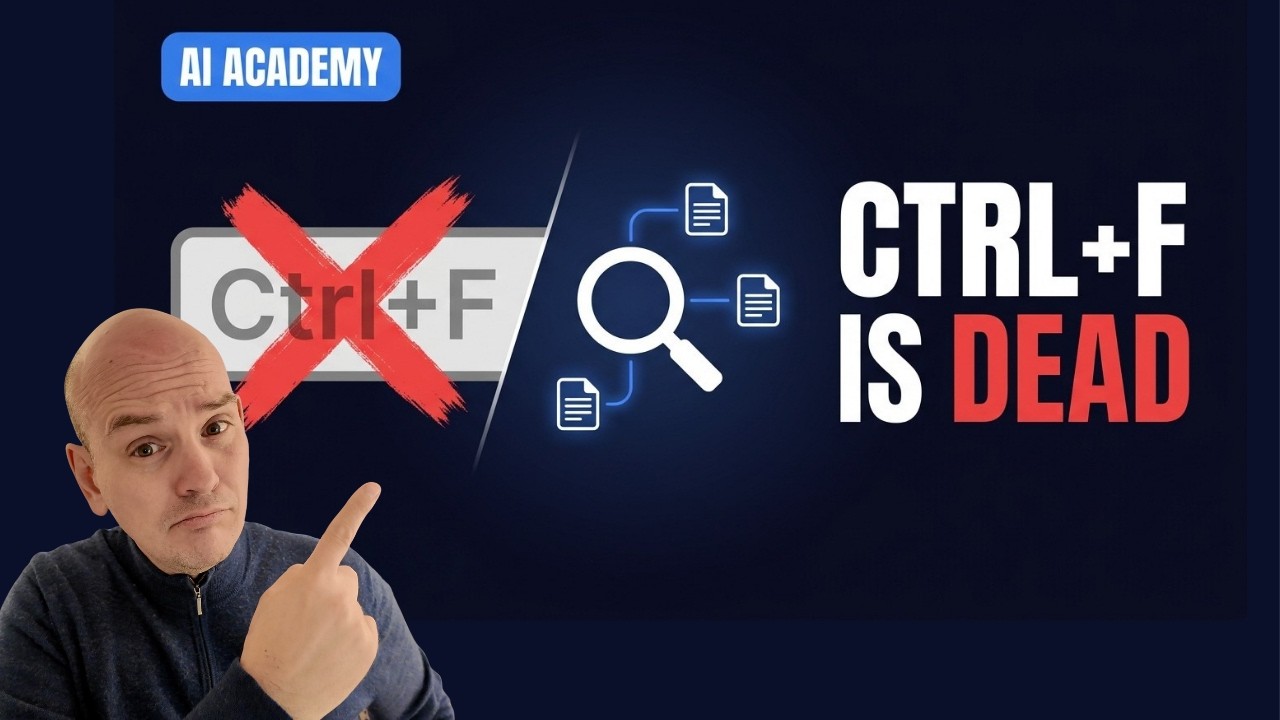
Think of traditional keyword search like using ctrl-f on your computer. You type exactly what you are looking for, and it only finds the exact words. Type “returns process” and it will not find “refund procedure” or “how to send something back”, even though they are about the exact same thing. That is the problem with keyword search. It is literal. It only knows how to match strings of characters.
Now imagine a different kind of search. One that understands what you mean, not just what you type. You search for “how do I handle a difficult customer” and it finds articles about “conflict resolution” and “de-escalation techniques”. That is semantic search, and it is what embeddings enable.
Here is how it works in plain English. When you create embeddings for your documents, you are turning every piece of text into a set of numbers. These numbers capture the meaning, not just the words. And here is the clever part. When you type a question, your question gets converted to numbers too. The search system then looks for documents whose numbers are closest to your question. Not exact matches. Closest meaning.
That is the librarian analogy from earlier coming to life. Your question sits on the shelf, and the search finds the documents sitting closest to it. Even if they use completely different words, if the meaning is similar, they appear nearby.
For your business, this matters if you have a knowledge base, an internal wiki, or a document library that people struggle to search. Traditional search gives them nothing if they do not know the exact terminology. Semantic search understands what they are actually asking about.
Want to explore AI for your business?
Book a free discovery call to discuss how AI can streamline your operations and unlock new opportunities.
calendar_today Book a discovery callFour Real Business Use Cases for Embeddings
Now let me give you some concrete examples of where embeddings are already making a difference in businesses like yours.
Document Search
Most companies have years of accumulated knowledge: policies, procedures, customer FAQs, internal memos. The old way of searching that was keyword based. If you typed “holiday policy” you only got exactly that. But embeddings understand meaning. Someone typing “how many days off can I take” would get the holiday policy returned too. For a business with even a few hundred documents, that is a massive time saver. The research shows semantic search can cut the time employees spend looking for information by around 40%.
Product Recommendations
If you run an e-commerce business, embeddings can power a recommendation engine that actually understands customer behaviour. It does not just match keywords. It understands that someone who bought running shoes might be interested in sports socks or fitness trackers, even if those products have completely different names and descriptions. Shopify stores are already using this, and the data shows it can increase average order value by about 10 to 15%.
Customer Intent Detection
This one is brilliant for support teams. When a customer sends a message, embeddings can work out what they actually want, even when their words are vague or poorly written. Someone writing “my order still has not turned up and I needed it for tomorrow” is not just a delivery query. The system understands the urgency and intent behind it. This means support tickets get sorted faster and routed to the right person. One company that tested this found it cut their average response time by about a quarter.
Contract Intelligence
If your business deals with contracts, whether you are in legal, procurement, or sales, embeddings can read through documents and pull out the key terms. Expiry dates, payment terms, renewal clauses, liability limits. It highlights what is standard and what is unusual. This saves hours of manual review. A mid-sized business doing a few hundred contracts a year can easily save a few thousand pounds in legal time.
The common thread across all four examples is the same: embeddings take information that already exists in your business and make it searchable, understandable, and actionable in ways that basic keyword matching simply cannot do.

Keyword vs Semantic Search: When to Use Each
Now let me give you a simple framework for deciding which type of search your business actually needs.
Ask yourself one question: are people searching for something specific that you have exact records for, or are they describing a problem or need in their own words?
If they are looking for exact matches, keyword search is probably fine. Product codes, invoice numbers, SKU numbers, that sort of thing. Someone types “INV-2024-0047” and they want that exact invoice. Keyword search handles that perfectly. It is fast, cheap, and reliable.
But if they are describing what they need in natural language, embeddings are what you want. A customer types “my order arrived damaged and I want a refund” and the system understands they are looking for returns and refund information, even though they never used the word “returns.” That is embeddings. It understands intent, not just words.
Here is the quick test. If your search users type the exact thing they are looking for, stick with keywords. If they describe their problem or question in their own words, you need embeddings.
For most SMEs, the sweet spot is a hybrid. Use keywords for your internal systems where people know what they are looking for. Use embeddings for customer-facing search where they are describing what they need in plain English.
The Limitations of Embeddings
Now let me be honest with you about where embeddings fall apart.
The first thing is that embeddings only work as well as the data you put in. If your documents are messy, inconsistent, or full of errors, the embeddings will capture that mess. Garbage in, garbage out. It is not magic.
The second issue is bias. Embeddings learn from the data they are trained on, and if that training data contains biases, the embeddings reflect those biases. In a business context, this might mean search results that unintentionally favour certain approaches or language patterns over others. You need to check where your data comes from.
Third, there is a technical setup required. Embedding-based search is not a simple plug-and-play solution. You need someone who knows how to set it up properly, integrate it with your existing systems, and maintain it. For a small business with limited technical resources, this could be a barrier.
Finally, embeddings work best with larger datasets. If you only have a few dozen documents, the semantic matching may not give you better results than simple keyword search. There is a threshold below which the extra complexity is not worth it.
So the honest answer is: embeddings are brilliant for the right situation, but they are not a universal solution. Know when they make sense and when they do not.
Key Takeaways
- Embeddings convert words into numbers that capture meaning, allowing AI to understand intent rather than just matching exact words
- Semantic search finds related content even without keyword matches—searching “HR policy” returns “hiring guidelines” and “staff handbooks”
- Document search with embeddings can reduce time spent looking for information by around 40%
- Product recommendation engines powered by embeddings can increase average order value by 10-15%
- Customer intent detection helps support teams route tickets faster, with some businesses seeing response times cut by 25%
- Use keyword search for exact matches like product codes and invoice numbers
- Use embeddings for natural language queries where customers describe what they need in their own words
- Most businesses benefit from a hybrid approach—keywords for internal systems, embeddings for customer-facing search
- Embeddings require clean, quality data—garbage in, garbage out
- Smaller document sets may not benefit from semantic search; there is a threshold below which keyword matching performs equally well
FAQ
What are embeddings in simple terms?
Embeddings are a way of converting words, phrases, or documents into numerical representations (lists of numbers) that capture their meaning. Similar concepts end up with similar numbers, allowing AI systems to understand that “HR policy” and “hiring guidelines” are related, even without matching keywords.
How do embeddings improve business search?
Embeddings enable semantic search, which understands what users mean rather than just what they type. Instead of requiring exact keyword matches, semantic search finds documents based on meaning—so searching “how many days off can I take” returns the holiday policy even though those exact words do not appear in the document.
When should I use keyword search instead of embeddings?
Use keyword search when users are looking for exact matches, such as product codes, invoice numbers, SKUs, or specific document titles. Keyword search is fast, cheap, and reliable for precise lookups where the user already knows exactly what they want.
What are the main limitations of using embeddings?
Embeddings only work as well as the data input—they reflect any mess or bias in your documents. They require technical setup and maintenance, making them less accessible for small businesses with limited resources. Additionally, they work best with larger datasets; with only a few dozen documents, keyword search may perform equally well.
How much can embeddings improve business operations?
Research shows document search can improve efficiency by around 40%, e-commerce product recommendations can increase average order value by 10-15%, and customer intent detection can reduce average response times by 25%. Results vary based on use case and data quality.
Want to explore AI for your business?
Book a free discovery call to discuss how AI can streamline your operations and unlock new opportunities.
calendar_today Book a discovery callOver to You
Now you understand why embeddings are quietly powering almost every useful AI tool out there right now—they are the reason modern AI understands what you mean, not just what you type.
If you have documents, internal knowledge, or a customer service FAQ, try plugging them into a semantic search tool and see what happens. You might be surprised how much better it works than ctrl-f.
What business challenge would embeddings help you solve? I would love to hear your thoughts in the comments.

Enjoyed this? Get The Boardroom AI Brief.
Every Tuesday, the 10 AI developments that actually matter for SMEs. One short email. Free.
Free · no spam · unsubscribe any time

// WRITTEN BY
James Anderson
AI and full-stack engineer helping SME owners understand and implement AI. Founder of AI in Business and host of the AI in Business channel on YouTube.
Learn more about James →[ MORE ] RELATED READING
You might also like.



// NEXT MOVE
Get the AI news that matters, every week.
Join The Boardroom AI Brief. One free email every Tuesday: the AI developments that matter for your business, rated for relevance and explained in plain English.