
A is for Algorithm
The first lesson in AI Business Academy. Understand what algorithms actually are and why they matter for your business.
// WATCH THE EPISODE
AI in Business on YouTube
Prefer video? Watch this week's full breakdown on the AI in Business YouTube channel.
Introduction
Welcome to the AI Business Academy. I’m James Anderson, and this is the very first lesson in a series designed to give business owners a clear, no-nonsense understanding of AI. No jargon, no hype, just plain English.
Every lesson tackles one core concept. We are going from A to Z, building your knowledge step by step, so that by the end you have a proper working understanding of AI and how it applies to your business. You do not need a technical background. You just need to be willing to pay attention for a few minutes each week.
We are starting with the absolute foundation. The word that gets used constantly in AI discussions but almost never gets explained properly: algorithm.
You’ve probably heard it a thousand times. Every tech article talks about algorithms. Every social media platform talks about their algorithm. AI tools run on algorithms. But what actually is an algorithm? Here is the thing. Once you understand what an algorithm is, everything else about AI makes more sense. It is the foundation that everything else sits on.
So let me break this down in plain English.
In a nutshell: An algorithm is a set of step-by-step instructions that takes an input, follows a process, and produces an output. They already run in your CRM, accounting software, and email marketing. The key question for any AI tool: does it follow fixed rules, or does it learn from data? Understanding this changes how you evaluate every piece of technology.
Where Does the Word Algorithm Come From?
Let’s start with the story. The word algorithm traces back to a Persian mathematician named Muhammad Ibn Musa al-Qaarizmi. Quite a mouthful. He lived in the 9th century. He worked in Baghdad at a place called the House of Wisdom, which was essentially the world’s leading research institution at the time. Scholars from across the world came there to study mathematics, astronomy, and science.
Al-Qaarizmi wrote books on arithmetic and algebra that laid the groundwork for systematic problem solving. I mean genuinely foundational. The word algebra itself comes from the title of one of his books. His name was Latinised into Algorithmi, and over the centuries that evolved into the word algorithm.
So the word we use today for complex AI systems actually comes from a scholar who lived over a thousand years ago. I think that is worth knowing. It reminds you that none of this is as new or as mysterious as the tech industry wants you to believe.
Now here is what matters for your business. Al-Qaarizmi did not invent a single answer to a single problem. He created a system, a framework. He took messy real-world problems and turned them into step-by-step methods anyone could follow. His book contained over 800 practical examples for business and legal problems of the time. Things like dividing inheritance, calculating trade payments, measuring land. Real everyday problems that merchants and landowners needed to solve.
And here is the part that blows most people away. Algorithms existed long before computers. Long division is an algorithm. Euclid’s method for finding the greatest common divisor of two numbers, developed over two thousand years ago, is essentially an algorithm. Navigation tables that sailors used across the oceans were algorithms. These are step-by-step instructions humans followed by hand for centuries. A computer just follows them faster.
What Actually Is an Algorithm?
So here is the formal definition. An algorithm is a finite set of well-defined instructions to solve a specific problem or perform a computation.
Every algorithm follows a three-part structure: input, process, output. You start with the information, you apply a method, and you get a result.
Now I want to clear up something that trips a lot of people up. An algorithm is not the same as a programme. An algorithm is the logic, the method, the approach to solving the problem. A programme is the code that implements the logic on a computer.
Think of it this way. The algorithm is the recipe. The programme is the act of cooking. You can write the same algorithm in ten different programming languages, just like you can cook the same recipe in ten different kitchens. The logic stays exactly the same.
Here is a simple example. Think about a thermostat. The input is the current temperature in the room. The process is comparing the temperature to the setting you chose. The output is the heating turning on or staying off. That decision process is an algorithm. Simple, rules-based, and running in millions of homes right now. No AI, no machine learning. Just a set of instructions doing exactly what they were designed to do.
What Is the Difference Between Rules-Based and Learning Algorithms?
Here is the distinction you need to understand. There are two different types of algorithms running in business today.
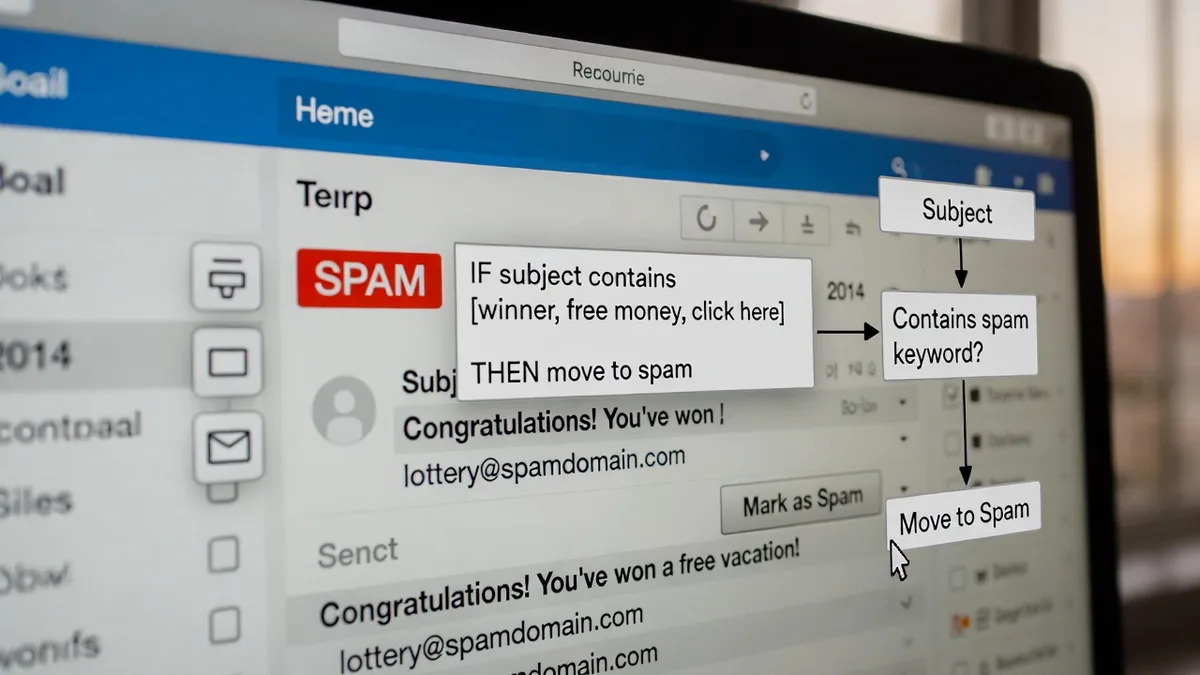
First, rules-based algorithms. These follow fixed if-then logic that never changes. Your email spam filter from ten years ago worked this way. If an email contains certain words, it moves it to spam. Same rule every time, forever. It does not learn. It does not adapt. It does exactly what someone told it to do.
Second, machine learning algorithms. These improve by finding patterns in data rather than following fixed rules. Your modern spam filter learns from which emails you mark as spam and which ones you do not. Over time, it gets better at predicting what you want to see and what you do not. It adapts.
And we will go much deeper into machine learning in a future lesson.
The question you should have in the back of your mind with any AI tool is simple. Is this following static rules or is it learning and adapting over time? That single question will come up again and again as we go through this series. And it is the most useful filter you can apply when someone is trying to sell you a piece of technology.
Where Are Algorithms Already Running in Your Business?
Where do algorithms already sit in your business? Let me walk you through where they are already working, probably without even thinking about it.
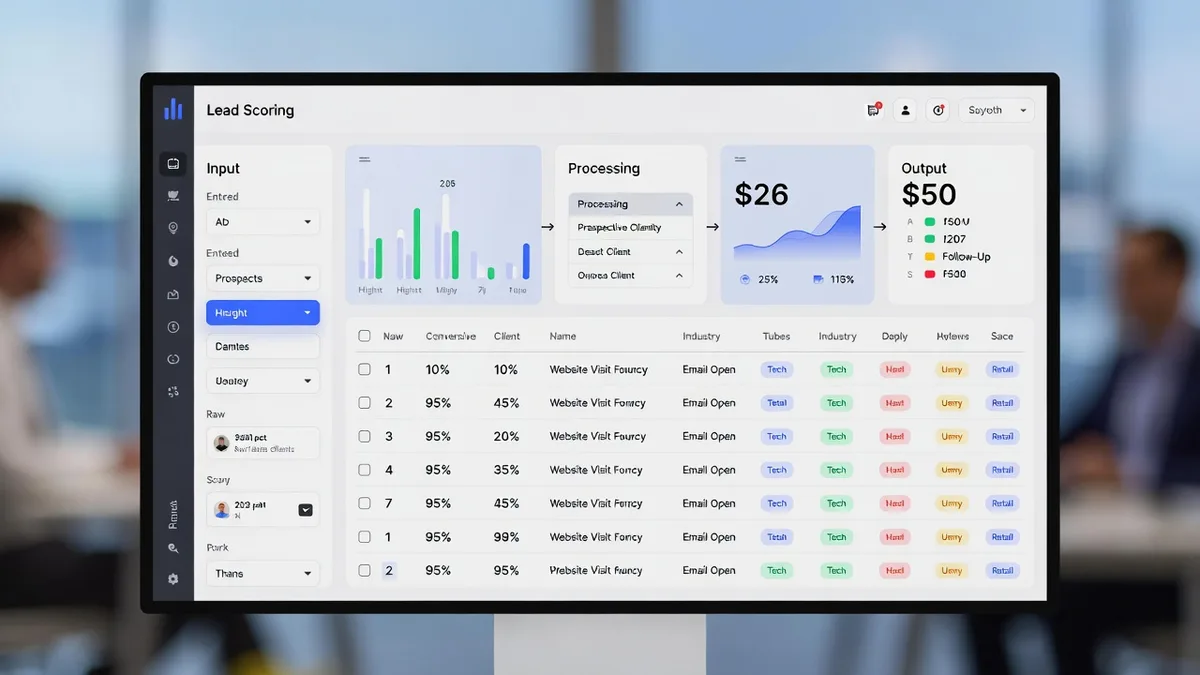
Open your current CRM system. When it scores leads based on how likely they are to convert, that is an algorithm. It takes information about a prospect, things like how often they visit your website, whether they have opened your emails, what industry they are in, and it runs all of that through a set of rules or a learning model. The output is a score that tells your sales team who to call first. That is input, process, output, and action. And if it gets the score wrong, your sales team waste time chasing the wrong prospects. The algorithm matters.
Your accounting software, when it categorises transactions automatically, that is an algorithm. You import a bank statement and the software looks at each transaction, matches it against patterns it has seen before, and decides whether it is office supplies or travel expenses. The more transactions it processes, the better it gets at guessing correctly. That is a learning algorithm at work. But if it miscategorises a big expense, your books are wrong and your accountant has questions. The algorithm matters.
Your email marketing platform, when it decides what time to send your campaign for maximum engagement, that is an algorithm. It analyses open rates across your subscriber list, looks at when different segments tend to read emails, and picks the optimal send time. You did not set that rule. The algorithm figured it out from data.
Your bank’s fraud detection. Every time you make a card payment, an algorithm checks the transaction against your normal spending patterns in real time. Unusual amounts, unusual locations, unusual time of day. Enough to trigger a block. And the transaction gets blocked. But that is an algorithm making a decision about your money in milliseconds. Get it right, you are protected. Get it wrong, you get declined when you try to pay abroad.
Stock reordering. Many inventory systems use algorithms to monitor stock levels and trigger purchase orders automatically when quantities drop below a threshold. No human checking a spreadsheet. The algorithm handles it all.
The point is, you are already trusting algorithms with real business decisions. You have been for years. The AI revolution is not about algorithms appearing in business for the first time. It is about algorithms getting much, much smarter.
Can Algorithms Be Biased?
And smarter does not always mean better. And this is something every business owner needs to understand.
In 2018, Amazon built a recruitment algorithm to screen job applications. It trained on ten years of hiring data. The problem was that most of those hires had been men. So the algorithm taught itself to penalise CVs that contain the word “woman”, as in “woman’s chess club” or “woman’s college”. Amazon scrapped the tool. But the lesson is important.
Algorithms learn from the data you feed them. If that data has biases baked in, the algorithm will amplify those biases at scale. It will not question the data. It will not flag a problem. It will just do what the patterns tell it to do, faster and more efficiently than a human could.
That is not just a big tech problem. That is a problem for any business using learning algorithms. And it is why understanding the basics matters, even if you never write a line of code.
Can Small Businesses Build Their Own Algorithms?
Most of the conversation around algorithms in AI is dominated by big tech and big corporations. And that can make it feel like this stuff is not for you. Like it is only for companies with massive budgets and data teams.
But here is the thing that has changed, and it is a big deal. Traditionally, building your own algorithms meant hiring in data scientists and software engineers. That was the barrier. The barrier has now come down dramatically over the past six months.
What has changed is access to large language models. Tools like ChatGPT and Claude have made it possible for businesses like yours to start building your own tools without needing a computer science degree.
So what does this look like in practice? Let me give you three examples.
First, your customer data. If you have emails, invoices, support tickets sitting in folders, that is an untapped resource. You can use an LLM to read through that data, identify patterns, and build an algorithm that automatically sorts new inquiries and spots customers who might be at risk of leaving.
Second, your internal knowledge. Every business has procedures, notes, and know-how scattered across different people’s heads and computers. You can feed that into an AI system and build something that answers questions for your team. How do we handle a refund? What is the process for onboarding a new client? That becomes searchable instantly.
Third, your operations data. Sales figures, inventory levels, staff schedules. If you are measuring it, you can start building algorithms that predict what comes next. Not guesswork, but informed predictions based on your actual patterns.
The key shift here is this. You are no longer dependent on third-party tools that were built for generic use cases. You can build for your data for your business at a fraction of what it used to cost.
Is it free? No. But it is affordable. You might be looking at a few hundred pounds to get something basic up and running, or a couple of thousand for something more useful. Compare that to the old way and this is a completely different conversation.
The question to ask yourself is this. What data do I have that I am not using? And that is where the opportunity is.

Key Takeaways
So let me leave you with three things to take away from this lesson.
First, the mental model. Anytime you hear the word algorithm, just think: a set of instructions that takes an input, follows a process, and produces an output. That is it. No mystery, no magic. Just logic.
Second, the filter. When you are evaluating any piece of business software, ask one question. Does it follow fixed rules or does it learn from data? Most of the tools you already use are in the first bucket. The new wave of AI tools sit in the second. Knowing which bucket you are looking at changes how you evaluate the tool, what you pay for it, and how much you trust its outputs.
Third, the data principle. A tool that learns is only as good as the data it learns from. Good data in, good decisions out. Bad data in, bad decisions out. But at scale and at speed. This is why understanding algorithms matters, even if you never touch the technology yourself.
You do not need to become a technical expert. That is not the purpose of this series. But knowing these basics puts you in a stronger position than most business owners who are already spending money on tools they cannot properly evaluate.
Over to You
So to distill this whole lesson down to one line, an algorithm is just a set of step-by-step instructions that solves a problem. That is the foundation everything else in AI is built on. That is your starting point.
Now you know what an algorithm is when you come across the term.
Where are algorithms already making decisions in your business? Drop a comment below.
Enjoyed this? Get The Boardroom AI Brief.
Every Tuesday, the 10 AI developments that actually matter for SMEs. One short email. Free.
Free · no spam · unsubscribe any time

// WRITTEN BY
James Anderson
AI and full-stack engineer helping SME owners understand and implement AI. Founder of AI in Business and host of the AI in Business channel on YouTube.
Learn more about James →[ MORE ] RELATED READING
You might also like.



// NEXT MOVE
Get the AI news that matters, every week.
Join The Boardroom AI Brief. One free email every Tuesday: the AI developments that matter for your business, rated for relevance and explained in plain English.