
AI Agents Explained for Business Owners | What They Actually Do
What exactly is an AI agent, how does it work, and could it help your business? A clear breakdown for SME owners.

// WATCH THE EPISODE
AI in Business on YouTube
Prefer video? Watch this week's full breakdown on the AI in Business YouTube channel.
Introduction
You have probably heard the term AI agents by now. It is being touted as the next big thing for your business. But what actually is an AI agent, and more importantly, could it help your business?
The honest answer is that most of what you have heard is a mix of genuine innovation and outright hype. Let me give you the clear, practical breakdown you need so you can separate what matters from what does not.
If you are a business owner spending too much time on repetitive tasks, this article is for you. Let us dig into what AI agents actually do and where they can genuinely add value to your operations.
In a nutshell: AI agents are software that act on your behalf to complete tasks — not just answer questions. They work best with repetitive, rule-based processes like email sorting, scheduling, and data entry. Costs range from free to a few hundred pounds per month. Start small, maintain human oversight, and test with low-risk processes first.
What Exactly Is an AI Agent?
An AI agent is software that acts on your behalf, rather than just answering questions.
Let me break this down in plain English. A chatbot like ChatGPT is reactive. You ask it something, it responds, and it waits for you to prompt it every single time. Think of it like a very knowledgeable colleague who will only help you when you come to their desk and ask a question.
An AI agent is different. You give it a goal, and it works towards that goal on its own. It does not need you to hold its hand through every step.
Here is a simple way to think about it. Imagine having an assistant who would handle things for you. They would go away, work on tasks, come back when it was done, or flag any issues along the way. An AI agent is essentially that, except it is software, not a person.
The key difference is autonomy. A chatbot is like a conversation. An agent is a task completion system.
How Do AI Agents Actually Work?
Now here is how it works in practice. You give the agent an objective, something like:
- Research our competitors and put together a summary
- Go through these customer emails and categorise them by priority
- Find available meeting times next week so we can schedule invites
The agent will then go away and figure out the steps needed to get there. It might search the web, read documents, send emails, or update a spreadsheet. It keeps working until the goal is reached, or it hits a problem it cannot solve.
This is fundamentally different from a chatbot because the agent takes action. It does not just talk about what could be done. It actually does the work.
Why Does This Matter for Your Business?
Most of us are spending far too much time on tasks that should not need our direct involvement. Answering the same customer questions over and over, chasing invoices, scheduling appointments, updating spreadsheets, processing orders. The list goes on and on.
These are exactly the kind of tasks where an AI agent can step in and handle things automatically.
Here is why it matters right now. Research from McKinsey estimates that AI could automate roughly 30% of the current work tasks across the economy. For a small business with five people, that is like getting an extra team member for free. Not by hiring more staff, not by working longer hours, but by letting software handle the repetitive stuff.
That is the real opportunity here. Every hour your team spends on tasks that a piece of software could handle is an hour they are not spending on your customers, your team, or growing your business.

What Do AI Agents Look Like in Different Industries?
Let me give you some concrete examples across different sectors.
If you run a retail business, an agent could monitor your inventory levels and automatically reorder stock when quantities drop below a threshold. It updates your records without you touching a keyboard.
If you run a professional services firm, an agent could sort and prioritise incoming inquiries, schedule consultations based on availability, and send reminder emails to clients.
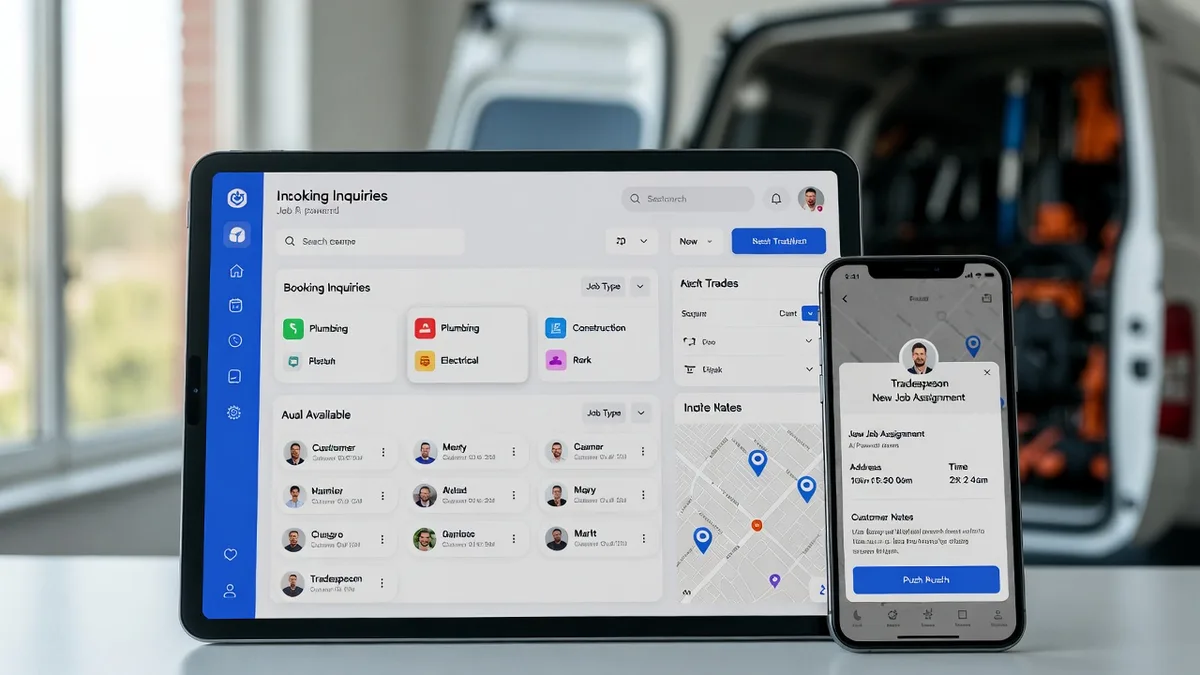
If you run a trades business, an agent could handle booking inquiries, match jobs to available engineers, and send job details to your team.
The sectors where this makes the most obvious impact right now are:
- Customer service
- Admin and data entry
- Scheduling and calendar management
- Invoicing and financial processing
- Marketing follow-ups
- Inventory management
But honestly, any business with a repetitive process that follows consistent rules has an opportunity here.
How Would an AI Agent Work in an Accountancy Firm?
Let me walk you through what this actually looks like in practice.
Imagine you run a small accountant firm. You have a general inquiries email address, something like info@yourcompany.co.uk. Every day, new emails land in the inbox. Some people are asking about your services, some want to know your prices, some are asking if you serve their area, and some are existing clients with questions about their accounts.
Right now, someone in your team will manage that. They will read every single one of those emails, figure out what the person wants, and either answer it or forward it to the right person. That takes time every single day. That is hours per week just spent on sorting routine emails.
Now here is where an AI agent would come in. When a new email arrives, the agent reads it, categorises it, and takes the next step.
- If someone is asking about your services, the agent sends them your pricing sheet and a brief introduction
- If someone is asking about an existing client matter, the agent forwards it to the appropriate account manager and flags it as routine
- If someone is asking something the agent cannot answer, it will flag it for human review
It is not a magic robot. It is software that follows the rules you set, makes decisions based on those rules, and takes action without you needing to be involved in every single step.
The same logic applies elsewhere. A construction company could have an agent collate weekly site updates from every project into a single summary for the project manager. A task that would normally take someone an hour or two done in seconds.

A retail business could have an agent answering order status questions and processing basic returns automatically by connecting to the inventory system.
The common thread is repetition. Tasks that happen regularly, follow consistent patterns, and require the same base logic every time. That is the kind of work that agents are perfect for.
And to be clear, this is not about replacing staff. It is about removing the repetitive drudgery that eats up their time so they can focus on the valuable work that you actually hired them for.
Are AI Agents Right for Your Business?
Let me give you a simple framework for evaluating whether AI agents are worth exploring in your business. Ask yourself these three questions:
One. Do you have repetitive tasks that follow consistent rules?
Two. Would automating those tasks save you meaningful time without creating an acceptable risk?
Three. Can you start small? You do not need to transform your entire operation. Pick one process, test it, and expand from there.
Even simple agents need someone checking on them first. Make sure that is covered.
A great place to start with agents is looking at marketing and content because it is non-sensitive, it is fairly generic, and it is a low-risk way to test the technology. We built marketing agents for companies whereby what they do is they will look at your brand guidelines, your company content structure, and then they can produce blog posts or social media posts or images relating to your business that can be posted online. This is really easy, low-hanging fruit that you can test AI on in your business.
How Much of the AI Agent Hype Is Real?
On the hype versus reality question, here is the honest truth. A lot of what you hear about agents is overblown. The technology has genuinely improved, but many of the use cases being promoted are either technically complex or not yet reliable enough for small businesses.
The real opportunity is the boring, predictable, repetitive stuff. Where agents struggle is anything that requires real judgement, nuance, or context that changes frequently. Handling a sensitive customer complaint, negotiating a deal, making a strategic decision. Those need a person.
But the routine operational tasks? This is where agents deliver real value today.
A common question I get is whether there is a real person behind the agent. The answer is no, not in the way people imagine. There is no human sitting there doing the work. It is software. But that software can connect to real tools and systems, which means it can actually perform actions in your business, not just talk about them.
What Do AI Agents Cost and Are They Secure?
On costs, you are looking at two main areas.
First, the tools themselves. Many agent platforms charge per task or per month, ranging from free or basic versions up to a few hundred pounds a month for more capable ones.
Second, if you need help setting it up, a developer could build a simple agent in a few hours. More complex integrations take longer, obviously. But the key is really to start simple.
Security is a real and valid concern. When you give an agent access to your systems, you are trusting it with data and permissions. Start with low-risk processes like the marketing example I mentioned. Do not hand it access to your bank accounts on day one. Use it for something like summarising your calendar or drafting routine emails first. As you build confidence, you can expand into more sensitive areas.
Key Takeaways
- An AI agent is software that acts on your behalf to complete tasks, not just answers questions like a chatbot
- They work best with repetitive tasks that follow consistent rules, such as email sorting, scheduling, and data entry
- McKinsey research suggests AI could automate around 30% of current work tasks, equivalent to an extra team member for small businesses
- Start with low-risk, non-sensitive processes like marketing content creation to test the technology
- Agents are not suitable for tasks requiring judgement, nuance, or frequently changing context
- Costs range from free to a few hundred pounds per month, with simple agents potentially built in a few hours
- Always maintain human oversight and start with minimal system permissions
Over to You
AI agents are software that act on your behalf, not just respond to questions. If you have repetitive processes that follow consistent rules, they could genuinely save you time and money. The key is to start simple, keep oversight in place, and be realistic about what they can and cannot do.
What repetitive task in your business would you most like to hand off to an AI agent? Drop a comment below.
Enjoyed this? Get The Boardroom AI Brief.
Every Tuesday, the 10 AI developments that actually matter for SMEs. One short email. Free.
Free · no spam · unsubscribe any time

// WRITTEN BY
James Anderson
AI and full-stack engineer helping SME owners understand and implement AI. Founder of AI in Business and host of the AI in Business channel on YouTube.
Learn more about James →[ MORE ] RELATED READING
You might also like.


// NEXT MOVE
Get the AI news that matters, every week.
Join The Boardroom AI Brief. One free email every Tuesday: the AI developments that matter for your business, rated for relevance and explained in plain English.