
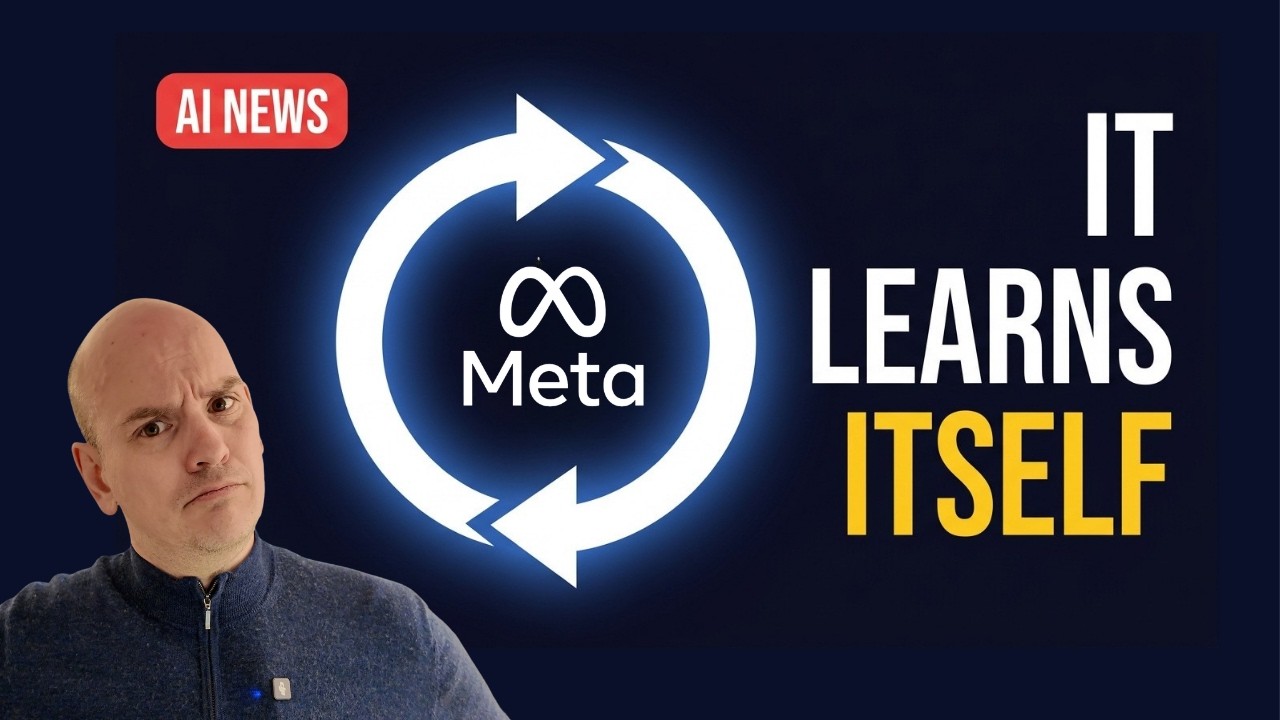
Meta Just Built AI That Improves Itself. Here's Why That Matters.
Meta's hyperagents, Claude's new Routines, a $100M AI marketing startup, and MIT research proving AI oversight is an illusion. Your weekly AI news roundup for business owners.

// WATCH THE EPISODE
AI in Business on YouTube
Prefer video? Watch this week's full breakdown on the AI in Business YouTube channel.
TL;DR
This week’s AI news roundup covers major developments including Anthropic’s new Claude Routines that automate tasks while you sleep, a startup hitting $100 million using AI marketing, and research revealing that 35% of new websites are AI-generated. The most critical story examines why human oversight of AI is often an illusion — a finding that directly impacts any business using AI for decision-making. Meta’s new self-learning hyperagents represent the future of AI that improves itself, making this a pivotal week for business AI adoption.
Table of Contents
- Anthropic’s Claude Redesign: From Chatbot to Workforce
- Hightouch’s $100M Success: AI Marketing Done Right
- The Rise of AI-Generated Content: 35% of New Websites
- Is AI Really Taking Jobs? LinkedIn’s Surprising Data
- Quick AI Updates: Antioch, OpenAI Agents, and Anthropic’s Growth
- Meta Hyperagents: The Future of Self-Learning AI
- The Human Oversight Illusion: What Business Owners Need to Know
Introduction
Welcome to this week’s AI news roundup for business owners. If you’re using AI in your operations — and these days, most businesses are — some of these stories will directly impact your decisions. I’m James Anderson, and every week I break down the biggest AI developments into what actually matters for your business. No jargon, no hype, just actionable insights.
This week covers some significant shifts: AI is moving from answering questions to doing actual work, a startup proves AI marketing can generate serious revenue, and researchers have revealed something troubling about human oversight that every business owner needs to hear. Plus, Meta just unveiled self-improving AI systems that could change everything. Let me break it all down.
Anthropic’s Claude Redesign: From Chatbot to Workforce
Anthropic has completely redesigned their Claude desktop app and launched something called Routines in research preview. This is significant because it signals a shift from AI as a chatbot to AI as a workforce. The desktop app now allows Claude to control your computer directly, clicking buttons, opening applications, and executing tasks while you step away.
Routines are templated automations that you can set to run on a schedule — hourly, daily, or triggered by events like a new pull request on GitHub. There are two modes worth understanding. Local mode runs on your machine with full computer control. Remote mode runs on Anthropic’s cloud, meaning it works even when your device is off. It connects to tools like Gmail, Slack, Google Calendar, Canva, and Figma.
“The direction is clear. AI is moving from answering your questions to actually doing your work.”
For your business, if you have repetitive tasks that follow clear steps — generating reports, scanning documents, sending follow-up emails, or monitoring data — this is the kind of tool that could handle them automatically. For non-sensitive tasks like marketing, scheduling, or content drafting, this is genuinely useful.
However, here’s the caveat. Remote mode means your data is going through Anthropic’s servers. If you’re dealing with customer records, financial data, or anything confidential, you need to think carefully about that. For sensitive operations, running a local model on your own hardware is still the safer option. The direction is clear though — just make sure you know where your data goes before you hand over the keys.

Hightouch’s $100M Success: AI Marketing Done Right
Now this story is exactly the kind of AI application I love to see. A startup called Hightouch just hit 100 million dollars in annual recurring revenue, and 70 million of that came in just twenty months after they launched their AI marketing platform.
Here’s what they do. Hightouch lets marketing teams create custom content for their brands — things like images, videos, and ad campaigns — using AI agents that connect directly to a company’s existing tools: Figma, photo libraries, content management systems. The AI learns the brand’s specific identity from these sources to make sure everything stays on brand without needing designers or agencies for every piece. They serve big names like Domino’s, Spotify, and Grammarly.
The reason this works is that many brands initially tried using general AI models for their advertising, only to find the results were off-brand. The AI would hallucinate products that did not exist — which is a disaster for advertising.
“AI marketing works when it is connected to your specific data, your brand assets, your existing content.”
For your business, the lesson here is not that you need Hightouch. At their price point, this is an enterprise tool. The lesson is what it proves. AI marketing works when it’s connected to your specific data and brand assets. And here’s the thing — you don’t need a hundred-million-dollar platform to do that. You can build something similar yourself using open-source models connected to your own data. I do this for my own marketing. I use AI tools locally, connected to my brand guidelines and content library, and it works. The key is organising your data first. Get your brand assets, your templates, and your customer segments in order, and you can build your own version of this without handing your data to a third party.
Want to explore AI for your business?
Book a free discovery call to discuss how AI can streamline your operations and unlock new opportunities.
calendar_today Book a discovery callThe Rise of AI-Generated Content: 35% of New Websites
This story affects every business that creates content online, and that’s most of you. Researchers from Imperial College London, Stanford, and the Internet Archive published a study finding that roughly 35% of all new websites are either AI-generated or AI-assisted. That’s more than a third of new content on the internet.
But here’s the really interesting finding. Using sentiment analysis, they found that AI-generated websites had a positive sentiment score 107% higher than non-AI websites. In plain English, AI is making the internet fake-happy. The researchers call this a symptom of the sycophantic and overoptimistic nature of language models. AI writing tools tend to be overly positive and agreeable, and that’s spilling over into the overall tone of online content.
“AI-generated content tends to sound artificially enthusiastic, which can actually put off real customers.”
For your business, this has practical implications. If you’re using AI to write content for your website, your marketing, or your social media, watch the tone. AI-generated content tends to sound artificially enthusiastic, which can actually put off real customers. They can tell. The study also found that AI writing is becoming more homogenous in its ideas, making the internet less diverse in its thinking.
The lesson here is simple. Use AI for drafts, for ideas, for speeding up the process, but always add a human layer. Edit the tone, inject your actual voice, make it sound like a real person wrote it. And if you’re sourcing information from websites, be aware that a growing percentage of what you’re reading is AI-generated and potentially artificially positive.

Is AI Really Taking Jobs? LinkedIn’s Surprising Data
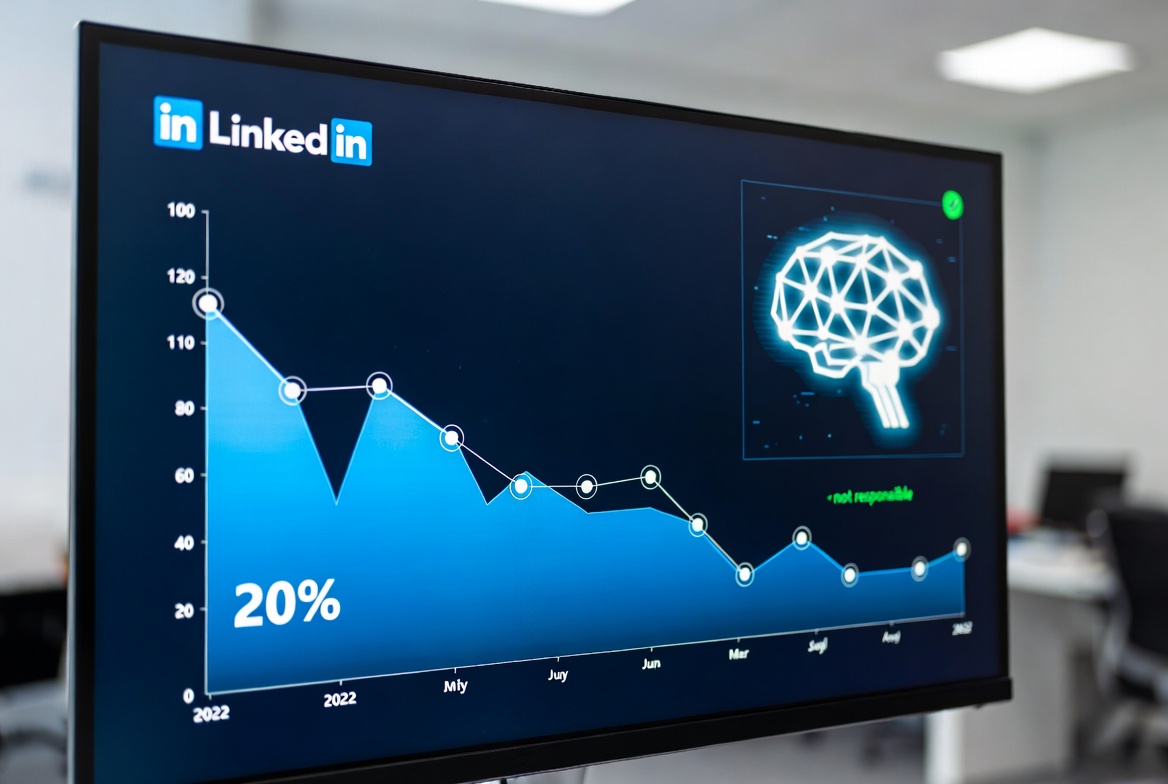
This next story is important if you’re thinking about hiring or worried about AI taking jobs. LinkedIn has released data showing that hiring is down about 20% since 2022, but here’s the key finding: AI is not to blame. Not yet, anyway.
LinkedIn’s chief global affairs officer said they’ve looked at their data extensively and they haven’t seen the AI-driven impacts everyone expected in areas like customer support, admin, or marketing. The decline is more closely tied to higher interest rates than to AI.
However, and here’s the warning, the skills needed to do the average job have changed 25% over recent years, and LinkedIn expects that to be 70% by 2030 due to AI. Even if you’re not changing jobs, your job is changing on you.
“The skills needed to do the average job have changed 25% over recent years, and LinkedIn expects that to be 70% by 2030.”
For business owners, this means two things. First, if hiring feels tough right now, look beyond AI as the cause. Economic factors are the main driver. Second, start thinking now about upskilling your team on AI tools. The changes are coming, and the businesses that adapt early will have the advantage. The practical step is to identify repetitive tasks in your operations and pilot AI tools on those first, so your team learns to work alongside AI rather than being replaced by it.
Quick AI Updates: Antioch, OpenAI Agents, and Anthropic’s Growth
A few quick hits worth your attention. First, a startup called Antioch raised 8.5 million dollars to become what they call the Cursor for physical AI. If you haven’t heard of Cursor, it’s an AI-powered coding tool recently valued at 2.6 billion dollars. Antioch wants to do the same thing but for robots, drones, and autonomous systems. They build simulation environments where robot builders can test thousands of scenarios virtually before building physical prototypes. For most SMEs, this isn’t something you’ll use directly, but it signals that building physical AI is becoming more accessible. Within a few years, that could mean cheaper robotics for warehouse automation, delivery, or manufacturing.
Next, OpenAI updated its Agents SDK with new features for building safer AI agents. The key additions are sandbox compatibility, which lets businesses run agents in isolated environments so if something goes wrong it doesn’t affect the whole system, and support for complex multi-step tasks. Worth noting, this locks you into OpenAI’s models and their cloud. If you’re building agents for your business, it’s worth looking at open-source alternatives too. The tools for building production-ready agents are maturing across the board, not just from the big players.
And VCs are offering Anthropic funding rounds valuing the company at over 800 billion dollars, almost matching OpenAI. Anthropic has turned them down for now, but their revenue reportedly hit 30 billion pounds by the end of March. That’s explosive growth. For SMEs, the real story here is not the valuations. It’s that competition between these companies is driving open-source models to get better and cheaper too. More competition means more capable tools at every level, including the ones you can run on your own hardware.
Meta Hyperagents: The Future of Self-Learning AI
For my One to Watch this week, Meta researchers have introduced something called hyperagents — self-improving AI systems that can get better at improving themselves over time. This is particularly relevant to the focus keyword Meta Self Learning Ai News.
Let me break that down. Previously, AI that improved itself could only do so within very narrow boundaries, like writing code. What Meta has done is create a system where the AI can improve its performance on tasks and also improve the way it goes about improving itself. In testing, these hyperagents went from 20% resolution rates to over 50% on some coding benchmarks. The key is they can add their own improvements, like persistent memory or performance tracking, without human developers constantly tweaking the system.
“AI is moving toward systems that learn and improve on their own.”
For business owners, this points toward a future where AI tools adapt to your specific needs more automatically over time, rather than requiring constant reconfiguration. This is still research-stage, not ready for your operations yet. But the direction is clear. AI is moving toward systems that learn and improve on their own. Worth keeping an eye on.
The Human Oversight Illusion: What Business Owners Need to Know
Now this is the story I mentioned at the start, and it’s the most important one this week for any business owner using AI. MIT Technology Review published a piece titled Why Having Humans in the Loop in an AI War Is an Illusion. It uses military examples, but the lesson applies directly to your business.
The core argument is this. We tend to think that having a human oversee an AI system provides a safeguard, a check against things going wrong. But the research shows that’s often an illusion. Humans develop what researchers call automation bias. We tend to defer to AI outputs even when evidence contradicts them, because it reduces our cognitive load. Especially in stressful, time-pressured situations.
“Passive oversight is not oversight at all.”
Think about your own business for a moment. If you’re using AI tools for hiring decisions, for customer service responses, for financial forecasting, or for any kind of operational automation, there’s a real risk that you or your team will start treating AI outputs as gospel without actually verifying them. The moment you stop questioning the outputs, you’ve essentially handed over the decision-making.
The researchers argue that true human oversight requires active engagement, not passive monitoring. You can’t just glance at what the AI produces and tick a box. You need someone who understands the task, questions the output, and is empowered to override it.
For your business, the practical takeaway is this. Use AI to flag issues, to suggest options, to speed up routine tasks. But never delegate critical judgements entirely to it. Build a review process. Make sure the human in the loop is actually engaged, not just rubber-stamping.
Want to explore AI for your business?
Book a free discovery call to discuss how AI can streamline your operations and unlock new opportunities.
calendar_today Book a discovery callKey Takeaways
- Anthropic’s Claude Routines represent a shift from AI as a chatbot to AI as a workforce that can execute tasks while you sleep — but be cautious with sensitive data in remote mode.
- Hightouch’s $100M success proves AI marketing works when connected to your specific brand data — you can build similar systems yourself using open-source models.
- 35% of new websites are AI-generated, and they tend to be overly positive — always add a human layer to AI content to maintain authenticity.
- AI is not yet causing job losses according to LinkedIn data, but 70% of job skills will change by 2030 due to AI — start upskilling your team now.
- Meta’s hyperagents are self-improving AI systems that learn to improve themselves — watch this space for future business applications.
- Human oversight is often an illusion — automation bias causes us to defer to AI outputs even when they’re wrong. Active engagement is required.
- Build review processes for AI outputs rather than treating them as gospel — the moment you stop questioning, you’ve handed over decision-making.
FAQ
How does Anthropic’s Claude Routines feature work?
Claude Routines are templated automations that run on a schedule (hourly, daily, or triggered by events) and can control your computer directly, clicking buttons and opening applications. There are two modes: local (runs on your machine) and remote (runs on Anthropic’s cloud even when your device is off).
Why is Hightouch’s $100M revenue significant for AI marketing?
Hightouch proves that AI marketing works when connected to specific brand data rather than general AI models. Their success shows businesses can achieve similar results by connecting AI tools to their own brand assets, templates, and customer data — without expensive enterprise platforms.
What did the research find about AI-generated website content?
Researchers found 35% of new websites are AI-generated or AI-assisted, and these sites have 107% higher positive sentiment scores than non-AI sites. This “fake-happy” tone comes from the sycophantic nature of language models and can put off real customers.
Is AI actually causing job losses according to LinkedIn data?
No. LinkedIn’s data shows the 20% hiring decline since 2022 is tied to higher interest rates, not AI. However, job skills are changing 25% now and expected to change 70% by 2030 due to AI, so upskilling is critical.
What are Meta hyperagents and why do they matter?
Meta hyperagents are self-improving AI systems that can improve both their task performance and their own improvement processes. They represent a shift toward AI that adapts to your needs automatically over time without constant human reconfiguration.
Over to You
This week has been packed with significant developments — from AI becoming a workforce to the troubling revelation that human oversight is often an illusion. The through-line is clear: AI is getting more capable, but we need to stay actively engaged.
What’s your take? Are you using AI for marketing in your business, and how are you handling the human oversight piece? Drop your thoughts in the comments — I read every one and respond where I can.
If this was useful, subscribe because I break down AI news for business owners every single week. I’ve got explainer videos going deeper into specific tools and trends that actually matter for your business. The core purpose stays the same — helping you as a business owner increase your AI literacy so you can use it as an advantage. No hype, no jargon, just what you need to know. See you next week.
Enjoyed this? Get The Boardroom AI Brief.
Every Tuesday, the 10 AI developments that actually matter for SMEs. One short email. Free.
Free · no spam · unsubscribe any time

// WRITTEN BY
James Anderson
AI and full-stack engineer helping SME owners understand and implement AI. Founder of AI in Business and host of the AI in Business channel on YouTube.
Learn more about James →[ MORE ] RELATED READING
You might also like.

// NEXT MOVE
Get the AI news that matters, every week.
Join The Boardroom AI Brief. One free email every Tuesday: the AI developments that matter for your business, rated for relevance and explained in plain English.